
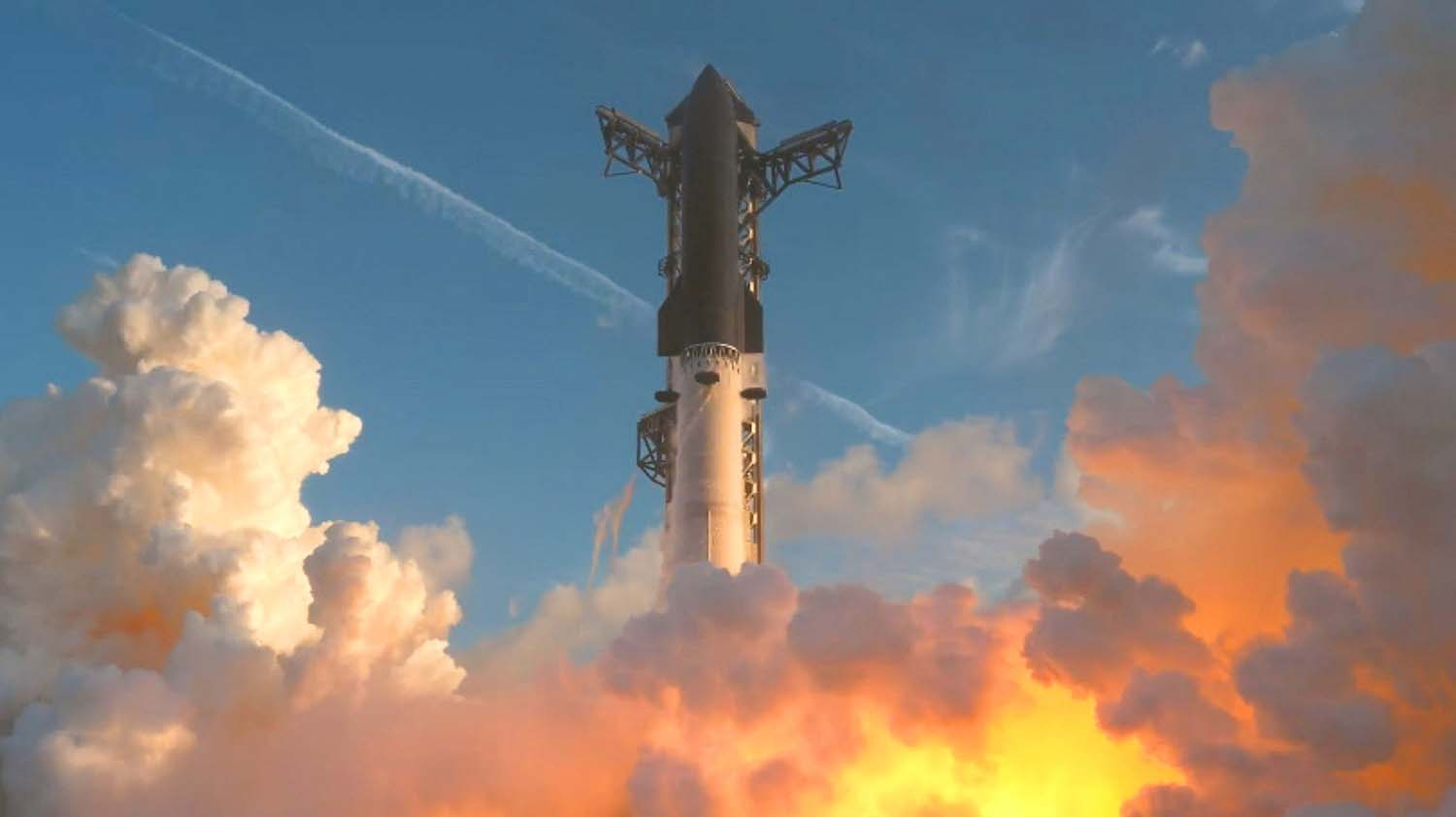
(NEW YORK) — SpaceX on Monday launched the world’s largest and most powerful rocket and spacecraft on a mission that marks the first time the spacecraft achieved orbit.
Starship splashed down in the Pacific, north of Hawaii, just before noon ET. Although the mission ended some seven hours earlier than planned, with the company choosing to return to Earth during the first scheduled mission checkpoint, SpaceX is calling flight 14 a success because it achieved both of its primary objectives: getting Starship into orbit for the first time and successfully adding Starlink satellites to its orbital constellation.
Starship’s 14th test flight was also the first Starship mission to make money for SpaceX; the company successfully deployed 26 Starlink satellites into orbit to build out its satellite internet division, SpaceX’s primary revenue generator.
Overall, this is the first time the Starship vehicle has reached orbit, deployed a revenue-generating payload and returned to Earth. While the company had some issues with two engines on the Super Heavy booster and one on the Starship spacecraft, the flight demonstrated that SpaceX is making significant progress with the Starship program, even if there is still work to be done.
The flight lifted off at 8:50 a.m. ET from SpaceX’s Starbase in Cameron County, Texas. The launch was initially scheduled for 8:15 a.m. ET but that was pushed Monday morning to 8:48 a.m. ET. Flight controllers had a 75-minute launch window to get the spacecraft off the pad.
Despite the spacecraft losing one engine during the ascent to space, which was not needed to achieve orbit, it successfully executed its orbital insertion burn.
Just over a half-hour into the mission, Starship began deploying its payload of 26 Starlink V3 satellites, marking the first time that the Starlink satellites have been placed into orbit for ongoing use. Previous missions deployed either Starlink simulators or satellites that burned up in the atmosphere.
The mission was scheduled to last just under 10 hours, with SpaceX is aiming for about six orbits, traveling at about 17,500 mph more than 170 miles above Earth. However, SpaceX decided to take advantage of their first scheduled checkpoint and ended the mission early, following the successful deployment of the Starlink satellites, making to total mission duration about three hours from launch to splashdown.
The company did not say what factored into their decision but pointed out that this is the longest SpaceX mission to date.
Starship lifted off atop the vehicle’s Super Heavy booster, which separated from from the spacecraft after launch and performed a boostback burn, designed to change its direction so it can return to Earth. After the landing burn, the booster successfully splashed down in the Gulf.
Starship started its flight on what SpaceX calls a “passively safe” suborbital/free-return path. This is the same trajectory the company used for previous missions.
The flight plan included regular vehicle health checks during the flight. SpaceX says Starship has more than 500 sensors that measure things such as temperature, pressure and acceleration during the mission. In addition, the vehicle provides flight controllers with continuous telemetry data.
At the end of the mission, Starship performed a deorbit burn using a single Raptor sea-level engine to prepare to reenter Earth’s atmosphere.
Copyright © 2026, ABC Audio. All rights reserved.

- ‘Icebreaker’ Netflix series casts Daisy Jelley, Connor Simos - September 28, 2026
- SpaceX Starship splashes down after successful 1st orbital flight test - September 28, 2026
- Democrats press HHS over legal representation of migrant children - September 28, 2026