
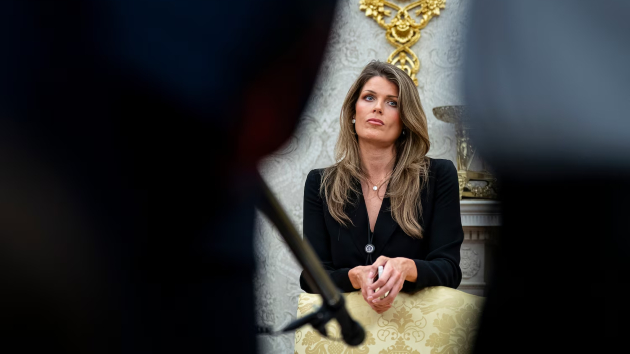
(WASHINGTON) — In an 11-page court filing, Attorney General Pam Bondi, Deputy Attorney General Todd Blanche and Acting U.S. attorney Lindsay Halligan blasted a federal judge Tuesday for what they called an “inquisition” against Halligan for continuing to represent herself as U.S. attorney for Eastern District of Virginia, after another judge found she was not legally allowed to serve in the role.
Halligan, a former White House aide who was appointed interim U.S. attorney by President Donald Trump, secured indictments against former FBI Director James Comey and New York Attorney General Letitia James, only to have them thrown out when U.S. District Judge Cameron McGowan Currie determined in November that she had been unlawfully appointed without being either Senate confirmed or appointed by the federal judiciary.
Last week, U.S. District Judge David Novak ordered the Justice Department to explain why Halligan was still using the title after her office issued an indictment in which she was identified as U.S. attorney in the document’s signature block.
In their court filing on Tuesday, Bondi, Blanche and Halligan slammed Judge Novak’s order.
“The Court’s thinly veiled threat to use attorney discipline to cudgel the Executive Branch into conforming its legal position in all criminal prosecutions to the views of a single district judge is a gross abuse of power and an affront to the separation of powers,” the filing said. “The bottom line is that Ms. Halligan has not ‘misrepresented’ anything and the Court is flat wrong to suggest that any change to the Government’s signature block is warranted in this or any other case.”
“Contrary to this Court’s suggestion, nothing in the Comey and James dismissal orders prohibits Ms. Halligan from performing the functions of or holding herself out as the United States Attorney,” said the filing. “Although Judge Currie concluded that Ms. Halligan was unlawfully appointed under Section 546, she did not purport to enjoin Ms. Halligan from continuing to oversee the office or from identifying herself as the United States Attorney in the Government’s signature blocks.”
The DOJ officials said Judge Novak had a “fixation” on Halligan’s signature block, which was “untethered from how federal courts actually operate.”
They argued that the court has no authority to strike her signature from the block.
Copyright © 2026, ABC Audio. All rights reserved.

- ‘Mayor of Kingstown’ season 5 starts production - March 13, 2026
- Road to the Oscars 2026: All about Sunday’s broadcast - March 13, 2026
- ‘I’ve never liked him’: ‘SNL’ cast members bust on Harry Styles for doing ‘much too much’ - March 13, 2026