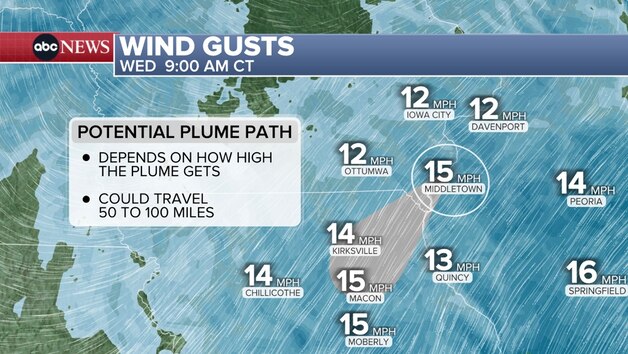

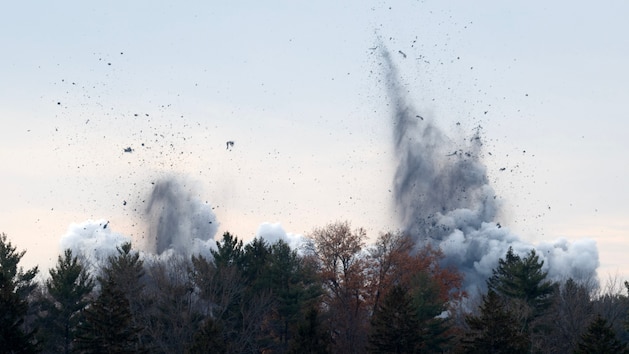
The U.S. Army detonated nearly five tons of lead azide at the Iowa Army Ammunition Plant in Middletown, Iowa, on Wednesday.
Winds are expected to carry the dust plume, which contains lead and potentially other toxins, into parts of southeast Iowa and northeast Missouri.
The Environment Protection Agency said in a statement after the detonation that “real-time air monitors are reporting ZERO detection of airborne lead.”
Health and environmental groups have expressed concern over the immediate and long-term exposure risks, both to human health and the surrounding environment, such as farmland.
Here are some resources available to people living in the affected areas.
Federal Emergency Management Agency
FEMA began supporting relocation on Tuesday for all residents of Middletown and people within five-mile cone to the southwest of the detonation site.
Evacuation support included “safe, sanitary and secure” shelter, transportation to a safe location for those unable to travel on their own, food and water, and other supplies, FEMA said.
Lodging will be provided through Friday, Nov. 27, but people are encouraged to call FEMA “if greater flexibility is needed.” according to the agency, which further said residents will receive a phone call when they are cleared to return home.
For information about available resources, individuals may call the FEMA Helpline at 1 (800)-621-3362.
Iowa Department of Health and Human Services
Iowa HHS said is coordinating with federal partners to ensure residents have access to timely and accurate information.
“Iowa HHS is providing and updating precautionary guidance to communities, monitoring available information in coordination with other state agencies, and keeping local public health partners informed,” the department wrote on its website. “Public health guidance will continue to be updated as more information is available.”
Currently, Iowa HHS recommends those within impacted areas stay inside and keep windows and doors closed for 24 to 48 hours after detonation.
Heating and ventilation systems are recommended to be turned off and residents should consider using a HEPA filter to reduce airborne particles indoors, according to Iowa HHS. Outdoor surfaces should be washed with soap and water if dust is present, the agency said.
American Lung Association
The American Lung Association said its free helpline is staffed by nurses and respiratory therapists who can answer questions to concerned callers in or near the detonation zone about the lungs, lung disease and lung health, including how to protect yourself.
To access the Lung Helpline, call 1 (800) LUNG-USA (586-4872).
U.S. Department of Agriculture
During a news conference on Tuesday, U.S. Department of Agriculture (USDA) Undersecretary Richard Fordyce said that approximately 350 farms in Iowa and Missouri could be impacted by the plume following detonation, according to ABC News local affiliate WOI-DT.
In a post on X, the USDA said officials are on the ground to assist farmers and livestock producers in southeast Iowa and northeast Missouri.
“Producers should reach out to their local [Farm Service Agency] county office for assistance with filing claims with the U.S. Army,” the USDA wrote in its post.
Residents who believe they sustained livestock health or property damage due to the detonation can file a claim with the U.S. Army by contacting the Office of the Staff Judge Advocate at 415 Custer Ave., Fort Leavenworth, KS 66027-2313 or by calling (913) 684-3564, the USDA said.
For USDA assistance, individuals can contact IowaResponse@usda.gov.
Copyright © 2026, ABC Audio. All rights reserved.

- ‘Avengers: Doomsday’ domestic presale numbers set to shatter box office records - November 25, 2026
- Resources, assistance available after US Army detonates nearly 5 tons of lead azide in Iowa - November 25, 2026
- Weekend Watchlist: What’s new in theaters, on streaming - November 25, 2026